
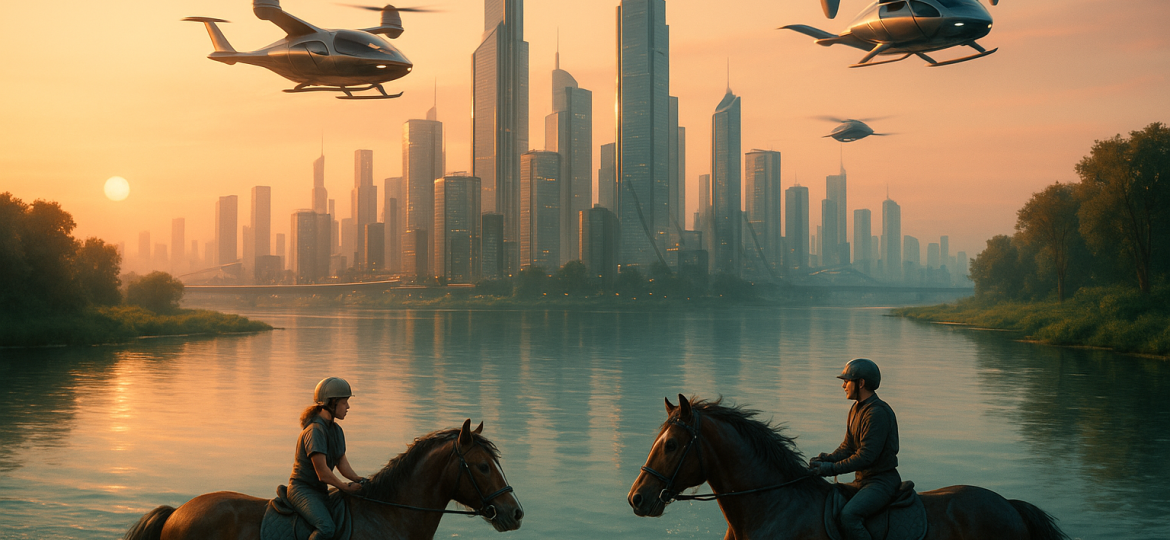
The morning commute in 2026 looks nothing like what our grandparents experienced. Above major cities, personal aircraft hum through designated sky corridors while down below, specially bred horses glide through rivers and canals. This isn’t science fiction – it’s the surprisingly diverse reality of modern transportation.
Personal Aircraft Finally Take Flight
Flying cars are no longer a dream. Personal Aerial Vehicles (PAVs) now buzz overhead in most metropolitan areas, offering wealthy commuters a way to skip traffic entirely. What once took hours through gridlocked streets now happens in minutes through the air.
The benefits are clear. Emergency services reach patients faster, packages arrive within hours instead of days, and suburban workers can live farther from city centers without punishing commutes. Medical drones and delivery vehicles have revolutionized how we move goods and services.
But this aerial revolution comes with trade-offs. The sky operates under strict regulations, with mandatory licensing, altitude limits, and no-fly zones over sensitive areas. The constant hum of electric rotors has become the new soundtrack of urban life – a persistent reminder that progress often means noise.
Swimming Horses Make a Splash
While technology conquers the skies, a different transportation trend emerges in waterways. Aquatic horses – specially bred Caspian and Shire-cross breeds enhanced for swimming – offer a surprisingly popular alternative to high-tech travel.
Originally developed for eco-tourism in national parks and wetland regions, these remarkable animals have found their way into mainstream transportation. Coastal cities use them for river tours, rural communities rely on them for wetland crossings, and wealthy families employ them for leisurely canal travel.
These swimming horses represent everything PAVs are not: silent, zero-emission, and deeply connected to the natural environment. They move at nature’s pace, offering riders a chance to disconnect from the fast-paced digital world.
Two Worlds, One Future
The contrast couldn’t be starker. Urban professionals blast off from rooftop sky-ports, racing against time and weather, while families in rural areas ford rivers on horseback, completely disconnected from the grid above.
This duality captures something essential about society in 2026. We desperately want both ultimate speed and deep connection to nature. PAVs solve the problem of physical distance, while aquatic horses address our growing spiritual distance from the environment.
One mode of transport represents our ambition to conquer our surroundings, the other our desire to live harmoniously within them. As we navigate this new landscape, it’s clear that the future of transportation isn’t a single path forward, but a complex network of choices – some soaring through the sky, others swimming gracefully through the water below.